_edited_edited_edited.jpg)
Career Transition at 50: How to Leave Well When Life Changes

Lost in Translation #4: Four Transitions
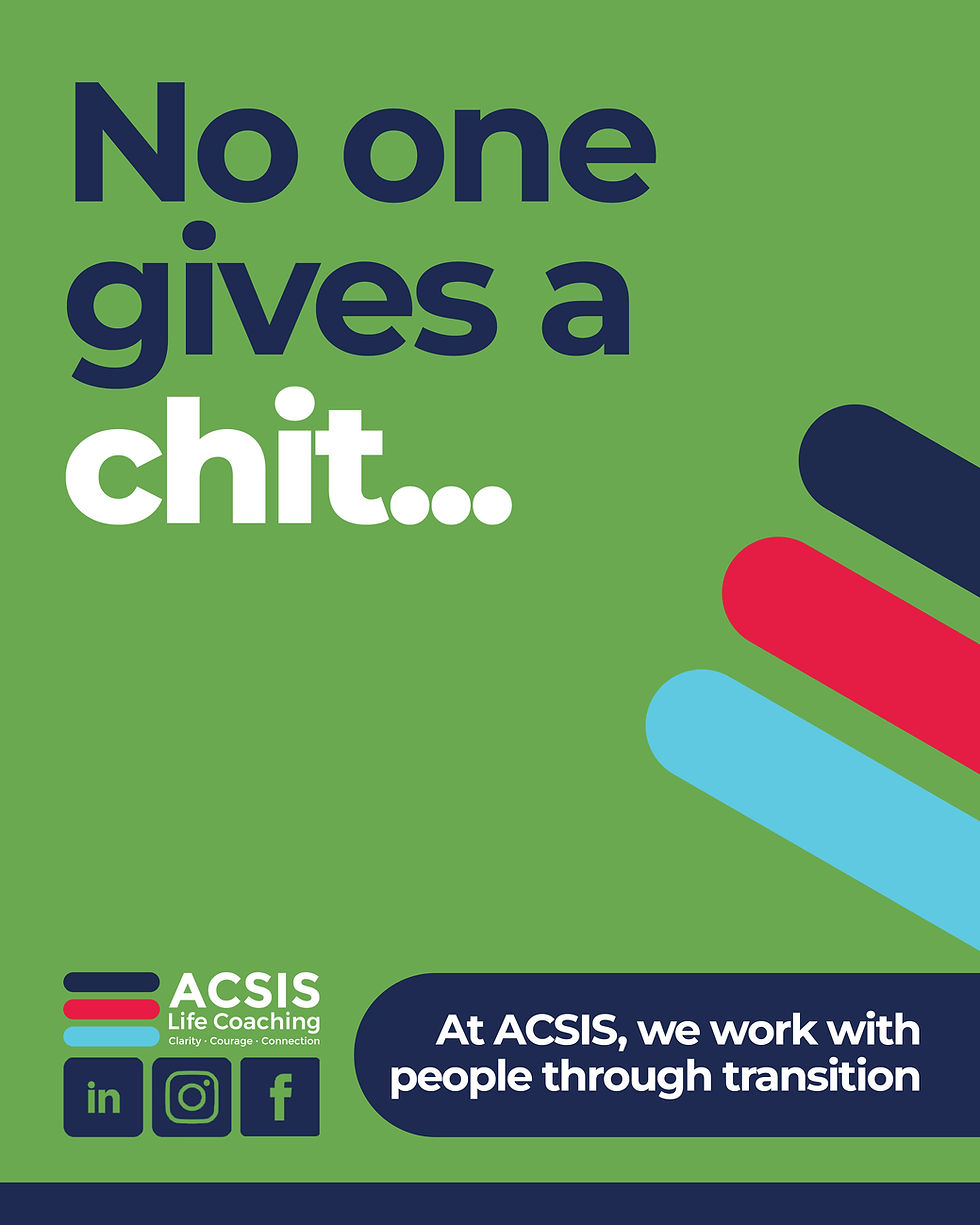
What nobody tells you about leaving well.
Nobody gives you a chit for this.
In the Navy (and the other services tbf), a chit is a request form. You fill one in when you need something official. Permission. Approval. A record that something happened.
There is no chit for what I am about to describe.
The moment, somewhere around your fiftieth birthday, when you realise that it is not just one thing changing. It is four. All at once. All without warning. All requiring something different from you at exactly the same time.
The Four Things
The first is the career. Nearly thirty years of service, a structure that has defined almost everything, your rank, your role, your routine, your identity, coming to its end. Late July handover. That is real and it is close.
The second is identity. Who am I when the uniform comes off? What is left when the rank slides off the shoulder? These are not abstract questions. They are the ones that arrive at 3am when the diary is quiet enough to let them in.
The third arrived without an invitation. Perimenopause. Hormones quietly renegotiating the terms of everything without consulting you first. Energy, sleep, mood, focus, all shifting in ways that do not always make sense until you understand what is actually happening.
The fourth is the season. Not the weather. The deeper kind.
Some people look at fifty and see autumn coming. I feel like I am in my decade's spring. Just starting out. A new season that has nothing to do with age and everything to do with what I am building.
Four things. All at once. No chit. No manual.
Just you, working it out as you go.
The 50th Birthday That Made It Visible
I had been struggling with perimenopause for a while before I properly understood it. The symptoms were there. The impact was real. But without the context, without naming it clearly, it was just a collection of things that felt harder than they should.
And then, around my fiftieth birthday, the picture came into focus.
Here was the career ending. Here was the business I was building with genuine excitement. Here was the doubt arriving alongside the excitement, the gremlin voice asking what if it is not successful, what if you are not enough, what if you are wrong about all of this.
And here, underneath all of it, was something I had not expected. A quiet guilt. A sense that perhaps I should have pushed harder, gone further, made it to a higher rank. That leaving felt like letting people down.
I sat with that for a while.
And what I found, when I looked at it honestly rather than just feeling it, was that the map other people had drawn for my career was not mine. Their hopes for me, however loving, however well-intentioned, were not my purpose. I did not lose anyone. The friendships held. But the guilt had been taking up space I needed for something else.
Letting go of it was not a betrayal.
It was clarity.
The Gremlin and the Ironman
Imposter syndrome is not a sign that you are not capable. It is a sign that you care about what you are doing. The two things can coexist.
My approach when the gremlin shows up is to write it down. Not to fight it, not to dismiss it, but to get it out of my head and onto paper where I can look at it without the emotion. Then I come back to it later, when I am calmer, and ask honestly: is this a real concern or am I overthinking?
More often than not, it is the latter.
But the single most useful thing I have ever done for my confidence was completing an Ironman. 3.8km swim. 180km bike. Full marathon to finish. When you cross that line you carry something away with you that no qualification can give you. The absolute knowledge that you can do hard things.
And that ANYTHING is possible (Firmly printed on my finisher's medal).
I did not just say that. I swam it, cycled it, and ran it.
The gremlin has a hard time arguing with that.
What the Research Says About Compound Transition
William Bridges, whose Transition Model has been a framework in coaching and organisational psychology for decades, identified three phases of any transition. The ending. The neutral zone. The new beginning. What he also noted was that transitions rarely arrive in isolation.
When multiple transitions converge, the psychological load increases significantly. Identity disruption, which researchers consistently identify as one of the most challenging aspects of any major life change, is compounded when several sources of identity shift simultaneously.
For women, the data on menopause in the workplace adds another layer. Research suggests that around 73 percent of women say menopause affects their work, and yet it remains one of the least discussed factors in career transition support.
Nobody hands you a framework for navigating four transitions at once. Which is exactly why having someone to think alongside makes such a difference.
This is not weakness. It is logistics. You would not navigate a nine-month deployment without a chart.
You do not have to navigate this without one either.
Late Summer. New Spring.
I said earlier that four things were changing at once. But here is what I have learned from sitting inside all of them.
They are not happening to me. They are happening for me.
The career ending is making space. The identity shift is an invitation. The hormonal change is a biological reality that deserves honesty, not silence. And the season?
I am in late summer by some measures. But in my fifties, in this new chapter, I feel like I am in spring. Just starting. The ground turned over. Everything still possible.
That is not denial. That is choice.
The choice to meet this transition with curiosity rather than fear. With an open mind rather than a fixed map.
With, if you will, the same attitude I wish I had taken to Cornwall in 2001.
Clarity, Courage, Connection
If you are waiting for someone to send your orders and realising they are not coming, here is what I would offer.
Clarity
Name all of it. Not just the career part, the tidy professional narrative. All of it. The hormones. The guilt. The gremlin. The grief about what is ending. Naming it does not make it bigger. It makes it manageable.
Courage
Letting go of someone else's map for your life is one of the bravest things you can do. Not because the people who drew it do not love you. But because it was never yours to follow.
Connection
You do not have to carry four transitions alone. Find your people. The ones who will sit with you in the complicated middle of it without trying to fix it or rush you through.
Looking for More Clarity, Courage and Connection?
If this blog struck a chord, ACSIS Life Coaching offers a calm, supportive space to help you reconnect with what keeps you steady, resilient and more like yourself.
Sam and Lloyd work with people who are carrying stress, pressure or emotional weight and want practical support to move forward with greater clarity, confidence and connection. Sometimes the shift starts with something big. Sometimes it starts with something smaller, a pause, a breath, a different perspective, a little more lightness.
👉 Book a FREE Clarity Session with ACSIS Life Coaching
👉 Visit acsis.co.uk or email contact@acsis.co.uk
FAQ: Career Transition at 50, Identity and Leaving Well
Why does career transition at 50 feel so overwhelming?
Career transition at 50 can feel overwhelming because it is rarely just about changing jobs. It can also affect identity, confidence, purpose, routine, health, family life and your sense of what comes next. When several of these changes happen at once, the emotional load can feel much heavier.
How do you leave a long career well?
Leaving a long career well starts with honesty. Name what is ending, what you are proud of, what you are ready to release and what you want to carry forward. Leaving well is not about pretending the transition is easy; it is about closing one chapter with clarity, respect and self-awareness.
Why is identity so difficult after leaving the military?
Identity can feel difficult after leaving the military because rank, role, routine and uniform often shape how people see themselves. When those structures are removed, many service leavers ask deeper questions about who they are, what they value and what their next mission will be.
Can perimenopause affect career confidence?
Yes. Perimenopause can affect energy, sleep, mood, concentration and confidence, which can all influence how someone experiences work and career change. Naming what is happening can make it easier to seek support, adjust expectations and make clearer decisions.
Is it normal to feel guilt when leaving the military or a long career?
Yes. It is common to feel guilt when leaving a long career, especially if other people had hopes or expectations for you. Guilt does not always mean you are making the wrong decision. Sometimes it simply means you are letting go of a map that was never fully yours.


Comments